One of the most overlooked parts of travel is not transportation. It is not passports. It is not hotels. It is not language barriers. It is water. Most people assume that because water appears clear, it must be safe. But experienced travelers eventually learn something surprising: Water can be perfectly normal for the local population and still create problems for visitors. Not because the water is necessarily unsafe. But because your body may not be accustomed to it.
Why Travelers Sometimes React to Local Water
People often say things like: “The locals drink it every day.” That may be true.
But local populations may have years, or generations, of adaptation to:
-
- regional microbes
- local mineral profiles
- environmental organisms
- food preparation methods
- background microbial exposure
Visitors arrive without that adaptation. Their digestive systems encounter a completely different environment overnight. This is why travel-related digestive upset remains one of the most common complaints among international travelers.
Travel Exposure Is Bigger Than Drinking Water
When people think of questionable water, they imagine drinking from rivers.
But exposure happens in many unexpected ways:
-
- ice cubes
- fresh produce rinsed in local water
- brushing teeth
- salads
- juices
- coffee
- tea
- shower exposure
- street food
- uncooked foods
- beverages diluted with local water
Even small repeated exposures may add up.
The Organisms Travelers Often Worry About
Water and food exposure discussions frequently include organisms such as:
Common Waterborne Concerns
-
- Giardia
- Cryptosporidium
- E. coli
- Salmonella
- Campylobacter
- Shigella
- Norovirus
- Hepatitis-related concerns
- General protozoa
- Environmental microbial exposure
Not every destination presents the same risks. But travelers often prepare anyway.
Why Chlorine Dioxide Became the Traveler’s Favorite
For decades, travelers had limited choices.
They could:
-
- boil water
- carry filters
- use iodine
- use chlorine tablets
- buy bottled water
Each works in certain situations. But chlorine dioxide gained a loyal following because it solved several problems simultaneously.
Travelers liked that it was:
-
- lightweight
- inexpensive
- compact
- long shelf-life when unmixed
- activated on demand
- effective in many water purification situations
- practical internationally
Most importantly: You carry tiny bottles. You create the purifier only when needed.
Why Two-Part Systems Are So Appealing
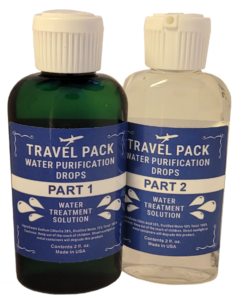
Most chlorine dioxide travel kits work by combining:
-
- Part 1
- Part 2
After activation, chlorine dioxide forms and is added to water.
This gives travelers several advantages:
Travel Benefits
-
- no bulky filtration equipment
- easy packing
- TSA-friendly travel sizes available from some manufacturers
- small enough for a pocket
- no batteries
- no pumping
- no electricity
For many travelers, this simplicity becomes addictive.
Why Travelers Often Prefer It Over Bottled Water
This surprises people. Many experienced travelers report that bottled water solves less than expected. Because bottled water:
-
- costs more
- creates plastic waste
- may not always be available
- sometimes has uncertain storage history
- does not help with produce, ice, or food preparation
Portable purification gives flexibility.
The Psychological Benefit Nobody Talks About
One unexpected benefit is peace of mind. Travel changes when water stops being a constant concern. Instead of asking: “Can I drink this?” People begin asking: “How do I enjoy this place?” That shift changes the experience.
A Traveler’s Water Mindset
Experienced travelers often think in layers:
Layer 1 — Choose Better Sources
-
- sealed beverages
- cleaner establishments
- flowing vs stagnant water
Layer 2 — Reduce Exposure
-
- avoid unnecessary raw foods
- use caution with ice
- wash strategically
Layer 3 — Prepare
-
- carry purification options
- have backup plans
- know contact times
Preparedness usually matters more than perfection.
Travel Is About Adaptation
One of the beautiful things about travel is that it expands us.
We experience:
-
- new foods
- new climates
- new ecosystems
- new cultures
- new environments
But every environment has its own biological fingerprint. Travelers do not need to fear that. They simply need to respect it.
Why Chlorine Dioxide Continues Growing in Popularity
Travelers continue choosing chlorine dioxide because it occupies a unique space: Too small to notice in your bag. Too useful to leave behind. It became popular not because travelers expect the worst. But because they want freedom.
Freedom to travel farther. Freedom to worry less. Freedom to drink with greater confidence.
That may explain why chlorine dioxide remains one of the most recognized portable water purification options among international travelers, hikers, emergency planners, and adventure communities.

Most travel problems do not begin with dramatic emergencies. They begin quietly. One meal. One drink. One cup of ice. One unfamiliar environment.
Travel does not require fear. It requires preparation. And for many travelers, carrying a compact water purification option has become as normal as carrying a passport. Because sometimes the difference between an unforgettable trip and a miserable one begins with something as simple as clean water.
FAQ
Q: Why do travelers use chlorine dioxide water purification drops?
A: Many travelers value them because they are lightweight, compact, shelf-stable, and used for water purification.
Q: Is bottled water always safer abroad?
A: Not necessarily. Travelers often also think about ice, produce washing, and preparation methods.
Q: What organisms are travelers concerned about?
A: Travel discussions commonly mention organisms such as Giardia, Cryptosporidium, E. coli, and other waterborne concerns.
Q: Are water purification drops better than filters?
A: Different methods solve different problems. Many travelers layer filtration and disinfection depending on conditions.
Q: Can chlorine dioxide remove chemicals or heavy metals?
A: No. Chemical disinfection and filtration address different categories of contaminants.
Disclaimer
This article is for educational purposes only. Chlorine dioxide is widely used for water purification and sanitation applications. Always follow manufacturer instructions and local travel guidance regarding drinking water safety. Water purification methods vary in effectiveness depending on water quality and contamination type. Chemical disinfection does not remove sediment, chemical pollutants, heavy metals, or all contaminants.